


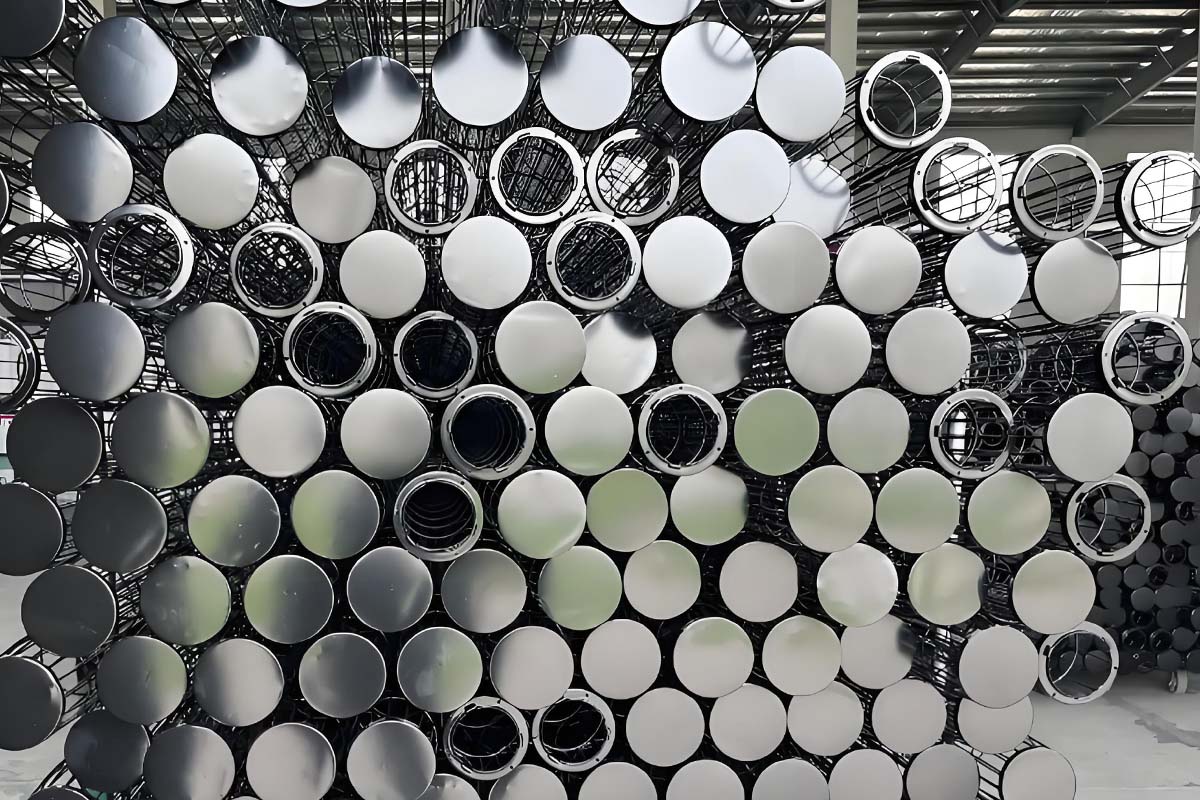
A Comprehensive Guide to Dust Filter Cages: Types, Measurement, and Installation
Currently, the market primarily offers the following four main types of dust filter cages (also known as bag cages):
Stainless Steel Cages: We make these cages from stainless steel, using grades like 201, 304, and 316. They are suitable for moderately corrosive environments or conditions with generally low to medium acid/alkali concentrations. However, due to their relatively high cost, customers often select stainless steel cages only for specific, specialized applications.
Galvanized Cages: We manufacture these cages by welding cold-drawn wire using specialized equipment and then applying a galvanized coating. This galvanization significantly enhances the cage’s rust resistance and helps reduce potential damage to the filter bags during replacement. While their low price made them the most common choice across various applications in the past, recent stringent environmental regulations on galvanizing plants have led to the closure of most facilities. Consequently, spray-coated cages have now largely replaced them.
Silicone-Coated Dust Cages: We construct these cages from carbon steel, forming them through a single welding process with specialized equipment. Then, we apply a surface treatment using electrostatic spraying of silicone powder. This type serves as an economical and practical option, frequently used in environments without high acidity or alkalinity and commonly specified for standard working conditions.
Spray-Coated Dust Cages: The base material and surface treatment process for these cages are identical to the silicone-coated type. The key difference lies in the temperature resistance, which varies between standard spray-coated and silicone-coated cages. Spray-coated cages also represent a commonly used product category.
Addressing Measurement Challenges in Dust Filter Cages
While defining the overall shape of a dust filter cage during ordering is straightforward, frequent deformation often leads to significant measurement difficulties. Although we use rigid, cold-drawn wire for construction, which provides inherent elasticity when unused (allowing the cage to return to its original size after minor deformation), this property diminishes over time. Prolonged use leads to rust corrosion, gradually reducing the cage’s elasticity. Consequently, more frequent bag replacements correlate with a higher cage damage rate. Sometimes, spare cages rust severely even before use. Furthermore, measuring deformed or damaged cages for CAD drawings is particularly error-prone.
Due to their slender, cylindrical frame structure (as opposed to a solid cylinder), measuring the overall length is simple, but accurately determining the outer diameter is challenging. Specifically, confusing the inner and outer diameters of the circular rings leads to major errors in calculating the circumference, while visual inspection often fails to reveal outer diameter inaccuracies because the frame’s inherent structure allows for natural tolerances.
The Role and Function of the Dust Filter Cage
The dust filter cage derives its name from its function: it acts as the internal framework for the filter bag, providing crucial support and maintaining shape—much like a skeleton. Therefore, people also call it the filter frame or bag cage. It plays a decisive role for both the filter bag and the baghouse dust collector itself. Without its support, the filter bag cannot effectively complete the cleaning cycle, rendering the entire dust collector system ineffective.
Dust Cage Installation Considerations
Before installation, we must first inspect the quality of both the filter bags and the dust cages. The bags should have no loose threads, skipped stitches, or untrimmed threads, and their dimensions must match the cage diameter. We also need to verify that the bag material conforms to the purchase order specifications. If any discrepancies exist, contact the supplier immediately for replacement.
High-quality dust cages must possess a smooth surface, be free of burrs, and have no missed welds. A simple quality check involves visual inspection for welding defects and running a white cotton glove over the surface; if the glove doesn’t snag, the surface is sufficiently smooth.
Criteria for High-Quality Dust Cages
A well-made dust cage requires adequate strength, rigidity, verticality, and dimensional accuracy to prevent deformation under pressure, damage during transport, contact between bags after installation, difficulty in bag insertion, or bag-to-cage abrasion. During manufacturing, all weld points must be solid and firm, with no loose, weak, or missing welds permitted. The surface must be smooth and straight, free of burrs, with even welding. For surface treatment, we can choose between spray coating or silicone coating. Applications requiring specific temperature, humidity, or enhanced corrosion resistance may necessitate galvanized or stainless-steel materials.
Filtration Mechanisms Overview
Packed Filter Bed Filtration: This method involves covering components like perforated rollers or plates with porous filter materials such as foam, non-woven fabric, or plush. It relies on the combined effect of surface and depth filtration to separate dust from the air stream. The primary advantages of this method are its high air volume capacity and relatively low resistance.
Filter Bag Filtration: The filter bag is a cylindrical body, typically circular, formed from a single layer of fabric. Its key characteristics are simple construction and ease of cleaning. As dusty air passes through the bag, it relies on mechanisms like sieving, impaction, and interception to separate dust from the air. The main advantages of bag filtration are its high efficiency (often exceeding 99.5% in textile mill applications), simple structure, and low power consumption. Disadvantages include a potential fire hazard, tendency for bag condensation, lower air volume per unit area, high fabric consumption, elevated dust concentration in the cleaned air shortly after cleaning, and potentially poorer labor conditions.
The dust removal mechanism in cage-supported filtration is a combined effect of short-range capture mechanisms, including sieve effects, direct interception, diffusion settlement, inertial impaction, and electrostatic adsorption. When dusty air passes through filter media like mesh, fabric, non-woven materials, or foam, the dust is separated by the dust layer formed on the surface and within the depth of the media, and by the filter cake built upon this layer. As the dust layer thickens, we must periodically remove it to ensure the continuous operation of the dust collection process. Textile fiber dust collectors can be classified by their structural design into categories like cage filtration, packed filter bed filtration, and filter bag dust collectors.
Successful air slide application stems from meticulous attention to detail. Establish a complete operational archive, record every failure and solution, and continuously optimize system parameters. Choosing an experienced supplier is equally vital, as they provide reliable technical support and proven solutions. Remember, prevention is always more cost-effective than repair. System reliability is built upon every single detail.

 English
  French
  Japanese
  Russian
  Arabic
  Portuguese