


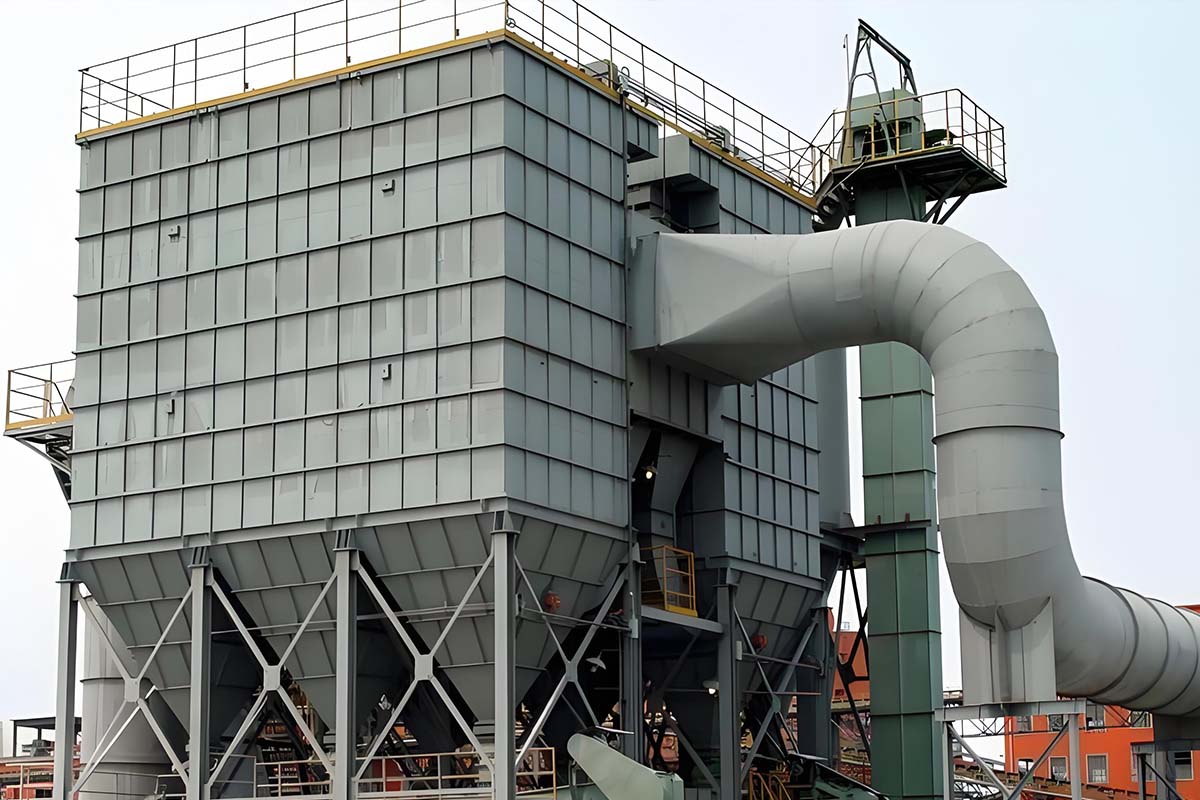
Bag Filter Dust Collectors: Overview of Principles and Classification
A bag filter dust collector is a highly efficient and reliable dry dust collection device. Its core function is to separate solid particles from dusty gas. It uses woven or felted filter fabric as the filtering medium. This equipment sees wide use across many industries. Its performance directly affects emission compliance and system stability.
(1). Main Classification Methods
Bag filters come in various designs to suit different process conditions. They are mainly classified as follows:
| Classification Basis | Type | Key Features & Description |
|---|---|---|
| Cleaning Method | Mechanical Shaking | Simple structure. Limited cleaning strength. Can damage filter bags. |
| Reverse Air (Air Ring) | Uses a moving air ring for continuous reverse-flow cleaning. | |
| Pulse Jet | The most common type today. Uses short bursts of compressed air for powerful, efficient cleaning. | |
| Airflow Direction | Inside-to-Out (Internal) | Dusty gas flows from inside the bag to outside. Dust collects inside the bag. No internal cage is needed. |
| Outside-to-In (External) | Dusty gas flows from outside the bag to inside. Dust collects outside the bag. A support cage is required to prevent bag collapse. | |
| Gas & Dust Flow | Co-current Flow | Gas flow direction matches dust fall direction during cleaning. Aids dust settling. |
| Counter-current Flow | Gas flow direction is opposite to dust fall direction. | |
| System Pressure | Positive Pressure | The fan is before the collector. It pushes dusty air in. Simple structure, but the fan handles abrasive dust and wears quickly. |
| Negative Pressure | The fan is after the collector. It draws clean air out. Better fan condition and longer life, but the housing must be strong and sealed for vacuum. More complex structure. | |
| Bag Shape | Round Bags | Most common. Simple structure, easy to install, clean, and replace. |
| Flat Bags | Allow more filter area in less space. Compact design, but cleaning and replacement are more complex. |
(2). Core Filtration Mechanisms
Filtration in a bag filter is not simple sieving. Instead, several physical mechanisms work together.
1. Sieving Effect
This is the primary mechanism. After a dust cake (primary layer) forms on the filter surface, its pores are much smaller than the fibers’ gaps. This effectively screens out finer dust. The stable dust cake is key to high efficiency.
2. Inertial Impaction
As air flows around filter fibers, larger dust particles cannot follow the streamlines due to inertia. They collide with the fibers and are collected. Larger particles and higher air speed increase this effect.
3. Diffusion
For very fine, sub-micron dust (especially <0.2 µm), Brownian motion is significant. These tiny particles move randomly, leave the gas stream, and hit the fibers. Lower air velocity increases diffusion.
4. Interception
When a dust particle’s radius is larger than the distance from its path center to a fiber, it touches the fiber. It is then intercepted and collected, even without much inertia.
5. Electrostatic Effects
Filter fibers and dust particles can carry electric charges. Opposite charges create attraction, improving collection. Similar charges create repulsion, potentially lowering efficiency. This effect is most notable with fine dust.
(3). Don’t Overlook Daily Preventive Maintenance
A new filter bag has low initial efficiency. During operation, the mechanisms above create a stable dust cake on the fabric. This cake has fine pores. It becomes the main filtering layer and greatly increases efficiency for fine particles.
Therefore, cleaning the bag does not mean removing all dust. The goal is to remove the excess dust layer while keeping the stable primary cake. This maintains high efficiency and low pressure drop for stable operation.

 Arabic
  English
  French
  Japanese
  Russian
  Portuguese